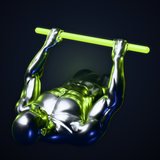
Dragon flag progression: six steps from the floor to a full flag, with the rep count for each
A dragon flag is lowering and raising your whole rigid body while only your upper back stays on a bench and your hands grip an anchor behind your head. Get there in steps: 15 lying leg raises, then tuck negatives, advanced tuck, straddle or one leg, full flag. Move on at 5 clean reps.
General information, not medical advice. Stop if you feel dizzy or unwell, and ask a professional about any health concern.
What a dragon flag is
You lie on a bench, grip something solid behind your head, roll up onto your upper back, and lower your body as one straight piece toward horizontal, then raise it again. Only your upper back touches the bench. Nothing bends at the hips.
Two strengths meet in it. Your abs stop your lower back from arching, and your arms pull down hard on the anchor, which is the straight-arm shoulder work that also carries over to the front lever.
What you can do today: lie on your back, arms by your sides, press your lower back flat, and do 10 slow lying tuck raises without letting the back lift. That number tells you where you start.
The move-on numbers
Every step has three levels. The last one opens the next step. These are the same numbers the app uses.
| Step | Levels | Move on at |
|---|---|---|
| Lying tuck raise | 5 / 10 / 15 reps | 15 reps, lower back down |
| Lying leg raise | 5 / 10 / 15 reps | 15 reps, lower back down |
| Tuck dragon flag negative | 1 / 3 / 5 reps | 5 slow negatives |
| Advanced tuck dragon flag | 1 / 3 / 5 reps | 5 reps down and up |
| Straddle or one-leg dragon flag | 1 / 3 / 5 reps | 5 reps |
| Dragon flag | 1 / 3 / 5 reps | 5 full reps, then weighted or one-arm |
Five clean reps is a strict-strength range: hard enough to prove the shape, short enough that every rep stays perfect. Most people who train the chain two or three times a week need several months to get from the first tuck negative to a full flag.
Your setup: bench, anchor, padding
- Anchor: grip the bench edge behind your head, a fixed bar, or a heavy piece of furniture that cannot tip. A straight bar lets you hold at shoulder width with straight or slightly bent arms.
- Bench: a flat bench lets your body lower below the bench line. The floor works too.
- Padding: fold a towel or mat under the upper back. That is where the load sits.
The neck and upper back take high pressure in this skill. Keep the weight on your shoulders and upper back, never on your neck. If you feel the load sliding into your neck, roll down and reset.
Step 1: lying tuck raise
Lie flat, arms by your sides, knees bent at about 90 degrees with the feet just off the floor. Flatten the lower back, pull the knees to the chest and curl the hips a few centimetres off the floor. Lower slowly until the feet hover.
Keep your hands out from under your hips. Wedging them there blocks the pelvis and takes the work away from the abs. If the back lifts as the feet go down, stop the feet higher.
Step 2: lying leg raise
Move on when
Same position with the legs straight and together. Raise them to vertical, lower them slowly with the back flat, and stop just above the floor or where the back starts to lift. Take 2 to 3 seconds on the way down.
High-volume plans push lying leg raises to 2 sets of 25. For the dragon flag, 15 strict reps with a flat back is the gate. The quality of the pelvic tilt is what transfers.
Step 3: tuck dragon flag negative
Move on when
Grip the anchor, tuck the knees and roll up onto your upper back. Open the hips so the trunk is in line, knees still tucked. Lower slowly, keeping the hips open. Roll back up any way you like and repeat.
Counts when: the tucked body lowers from the top with the hips open, at a steady pace, to near the bench, without the lower back arching.
Dosage: three sets of 3 to 6 slow negatives. Rest 2 minutes. Train them on two or three non-consecutive days.
The fault to catch is the hunchback: bending at the hips as you lower. Squeeze the glutes and keep the trunk straight even with the knees tucked. Tucked rolls, rolling up onto the upper back as high as you can and back down, 3 sets of 8, teach the balance point first.
Step 4: advanced tuck dragon flag
Move on when
Now the reps go both ways. Roll up, open the hips so knees, hips and shoulders line up, knees bent at about 90 degrees. Lower as far as you can without arching, then pull back up without bending at the hips.
Go only as low as you can come back from. If you pike to get back up, the depth was too much. Pull your elbows toward your stomach, and brace at the top before each rep.
Dosage: 3 x 3 to 8 reps, a 2 minute break between sets, two or three times weekly.
Step 5: straddle or one-leg dragon flag
Move on when
Lengthen the lever in one of two ways: legs straight and spread wide, or one leg straight and the other bent. Which is easier differs from person to person, so pick the one that lets you keep the line.
If you use the one-leg version, switch legs every set. Training only one side loads the core unevenly. When the back is about to arch at the bottom, tuck the knees and finish the rep tucked.
Drills: one-leg negatives, 3 sets of 3 per side. A stretched-out hold at the top with the legs in a straight line, 3 sets of 15 to 20 s.
Step 6: the full dragon flag
Move on when
Grip hard, roll up, extend to a straight line with the legs together and toes pointed. Lower as one unit toward horizontal, pause above the bench without arching, and raise back to the top without piking.
Counts when: the body stays straight from shoulders to feet on the way down and up, with no pike, no arch, and only the upper back touching.
Until full reps arrive, do 3 sets of 1 to 5 plus negatives: lower at a steady tempo and tuck when the back is about to arch. Once you own full reps, work them at 3 sets of 5 to 15. A static hold at your deepest clean angle, 3 sets of 10 to 30 s, also builds the bottom range.
Move on when
After the full flag
Three branches open at 5 full reps, each with the same 1, 3 and 5 rep levels.
- Weighted dragon flag: ankle weights strapped on above the ankles. Start at about 1 kg per leg and add weight only when 5 reps stay clean.
- One-arm dragon flag: one hand on the anchor, the free arm along the body or out to the side, hips square so the body does not twist. Counted per side, 5 per side to finish the line.
- One-leg dragon press: lying face up, the hands press the floor beside the hips and lift the body onto the mid back, one leg straight and the other tucked. Counted per side, 5 per side opens the full dragon press.
Mistakes that end the rep
- Banana back. The lower back arches near the bottom. Reduce depth or shorten the lever.
- Piking up. The hips bend to get back to the top. Use a one-leg tuck on the way up until the full lift is strong.
- Momentum. Swinging down and bouncing up. Pause at the top and the bottom.
- Weight on the neck. Shift onto the upper back and shoulders, and pad the contact point.
What supports it on the map
The hollow body hold is the same anti-arch shape lying still, and a 60 s hollow is a good companion goal. The hanging leg raise builds the same lower-ab curl from a bar. The V-sit progression trains the opposite direction: compression instead of extension control.
Questions people ask
How many dragon flag reps before moving on?
Five clean reps. Every flag step has three levels, 1, 3 and 5 clean reps, and 5 opens the next shape. The two floor steps before the flag, lying tuck raises and lying leg raises, move on at 15.
Can I do a dragon flag on the floor?
Yes, if you can grip something that will not move behind your head: a heavy sofa, a fixed bar or a sturdy post. A bench is more comfortable because your hips can drop below your shoulders. Pad the upper back either way.
Why does my lower back arch in a dragon flag?
The lever is longer than your core can hold at that depth. Stop higher, bend the knees, or switch to one leg tucked. Arching under load stresses the lower back, so treat it as the end of the rep, not a phase of it.
Are dragon flag negatives enough to learn the skill?
They are the entry step. Tuck negatives teach where to balance on the upper back and how to lower with the hips open. Once you can lower 5 slow tuck negatives cleanly, start full reps with the knees bent, going down and back up.
Made by EASYTECH, who also make Calisthenics.