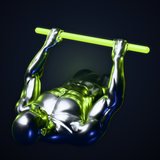
Frog stand: how to balance on your hands, and the five skills it opens
A frog stand is a crouched balance on your hands with your knees resting on the backs of your upper arms. Lean forward until your feet float, brake with your fingertips, and build to 30 s. At a steady 20 s, start the straight-arm frog stand, the first step toward the planche.
General information, not medical advice. Stop if you feel dizzy or unwell, and ask a professional about any health concern.
The first time your feet leave the floor
The frog stand is where most people balance on their hands for the first time. It needs little strength, a few push-ups and wrists that tolerate your weight. What it teaches is the lean: shifting your shoulders over your fingers until the feet float, then steering with the fingertips.
If you can do a handful of clean push-ups, you can start today.
How to do a frog stand
- Squat down and set your hands flat, shoulder width, fingers spread and turned slightly out.
- Rest your knees on the backs of your upper arms, just above the elbows.
- Press knees and arms into each other.
- Lean forward slowly until the feet float.
- Balance with your fingers. Keep breathing.
Put a pillow or folded mat in front of your face while you learn. To bail, tuck the chin and drop onto one shoulder over a mat if you tip forward.
The hold counts while both feet are off the floor and your head is clear of it. Time stops when a foot or the head touches.
Dose: 5 to 8 attempts of 10 to 30 seconds, about 1 minute rest, 3 to 5 times a week.
Three mistakes and their fixes
- Feet stay glued down. You are not leaning far enough. Shift the shoulders forward over your fingers.
- Tipping onto your face. Press the fingertips into the floor to brake. The pillow is there for the rest.
- Knees slide off the arms. Squeeze legs and arms together on purpose for the whole hold.
Two drills if the balance will not come:
- Frog rocks: knees on arms, rock forward until the toes get light, then back. 3 x 8.
- One-foot lift: lean and lift one foot at a time. 3 x 5 per side.
You can also build the position with a block under the feet: tiptoe-supported, then one foot supported, then free.
When to move on
| Hold | What it means |
|---|---|
| 10 s | Level 1: the balance clearly stops |
| 20 s | Level 2: start the next step |
| 30 s | Level 3: the frog is solid |
| 60 s of quality work | Gymnastics-style base, collected over sets |
Start the next step at a steady 20 seconds and keep the frog in your warm-up until 30 is easy. Sixty seconds of a beginner balance is a long wait for a skill that opens so much.
Move on when
Bent arms vs straight arms
The basic frog stand is the one static hold where bent elbows are part of the exercise. For everything after it, one rule from gymnastics applies: almost straight is still bent.
| Frog stand | Straight-arm frog stand | |
|---|---|---|
| Elbows | Bent, knees resting on them | Locked straight the whole hold |
| Knees | On the backs of the upper arms, above the elbows | Higher, near the armpits |
| Shoulders | Lean forward | Lean forward and push the floor away |
| Leads to | Elbow lever, press to handstand | Tuck planche |
| Levels | 10, 20, 30 s | 10, 20, 30 s |
How to do the straight-arm frog stand. Lock the elbows before you start. Place the knees high on the upper arms. Push the floor away, round the upper back slightly, and lean until the feet lift. If the elbows bend to save the balance, lean less: a bent-arm version is a normal frog, and it does not count here.
Dose: 4 to 6 holds of 10 to 30 seconds, 1 to 2 minutes rest, 3 times a week, early in the session when you are fresh.
Move on when
What the frog stand opens on the map
This is why the frog stand matters more than its difficulty suggests. Five skills hang off it:
- Straight-arm frog stand, then the tuck planche and the whole planche progression. A 20 s frog stand is the classic entry to the tuck planche, and bending the arms in a tuck planche turns it back into a frog.
- Straddle elbow lever, the first step of the elbow lever. Same lean, but the elbows dig into your stomach.
- Frog stand press, from the frog up into a handstand on bent arms. Lean further, lift the hips over the hands, release the knees, extend the legs, straighten the arms. The levels are 1, 3 and 5 presses. The same lift done from a headstand against a wall is a good first drill.
- Ring frog stand, the same balance on low rings. Keep the rings close to the body and low enough that a slip is a short step down.
- Turtle planche, a balance from breakdancing that builds on the same forward lean.
Frog stand to handstand
Two links connect them. The balance: the frog stand balance works like the handstand balance, steering with the fingers. The press: once you hold a frog and a headstand comfortably, the frog stand press lifts you from one to the other.
If you have a wall handstand already, keep both. The handstand guide covers the wall steps.
Wrists first
Your full body weight sits on bent-back wrists. Warm them up before every session: kneel on all fours and rock gently over your hands with the fingers forward, out and back, two rounds of ten, then ten palm lifts. Build time gradually. Fingers turned slightly out, or parallettes, reduce the bend. Parallettes or a wedge also make most press work kinder to the wrists.
Questions people ask
How long should I hold a frog stand?
The levels are 10, 20 and 30 seconds. Start the next step at a steady 20 s and keep building toward 30 in the warm-up. Gymnastics coaches who want a rock-solid base ask for 60 s of quality work, which you can collect over a few sets.
Is a frog stand the same as a crow pose?
The names overlap. Many coaches treat frog stand and crow as one drill, and yoga classes teach the same balance as crow pose. Both rest the knees on the arms with bent elbows. On our map it is the frog stand: knees on the backs of the upper arms, just above the elbows.
Does the frog stand help with the handstand?
Yes, for balance. The frog stand balance works like the handstand balance: you steer with your fingers. On our map it also opens the frog stand press, which takes you from the frog up into a handstand.
My wrists hurt in the frog stand. What can I do?
Warm the wrists up before every session, turn the fingers slightly out, and keep holds short at first. Parallettes keep the wrist closer to straight. If the pain is sharp, stop for the day and drop back to push-ups and wrist work for a while.
Made by EASYTECH, who also make Calisthenics.