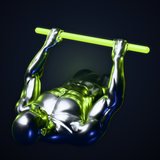
Pike push-up: the form that makes it count, and the steps from here to a handstand push-up
For a pike push-up, start in an inverted V with your hips high, lower with the elbows pointing back until your head touches the floor ahead of your hands, then press back up. Build to 3 sets of 8 clean reps, then raise your feet on a box for the decline pike push-up, the next step toward the handstand push-up.
General information, not medical advice. Stop if you feel dizzy or unwell, and ask a professional about any health concern.
The pike push-up is a handstand push-up with your feet on the floor. That is why it is worth doing well: every cue you learn here carries straight into the wall and freestanding versions. Done badly, it turns into a sloppy push-up with your hips in the air and teaches you nothing about pressing overhead.
Before you start
Get to 10 clean push-ups first. Our map opens the pike push-up when the push-up reaches 10 and treats 20 as the full move-on number. If you are not there, start with the push-up guide. A 30 second hold in the pike position, weight forward over the hands, is a good test that your shoulders are ready to take load overhead.
How to do a pike push-up
- Set up. Start in a push-up position, hands shoulder width or a little wider. Walk the feet in until your body makes an upside-down V, hips as high as you can get them.
- Shift forward. Move your weight onto your toes and over your hands.
- Lower. Bend the elbows so they point back, not out.
- Head forward. Bring your head down to the floor ahead of your fingertips, so head and hands make a triangle.
- Touch and press. Touch the nose or forehead lightly to the floor, then press back to the same pike.
Cues to keep in your head: head ahead of the hands, elbows back, hips high, nose to the floor.
Fix your distance. Keep the hands about 90 cm (36 inches) from the feet every session, so the reps are comparable week to week. Walking the feet in until the hips are mostly stacked over the shoulders gives a steeper pike that makes it harder. Pick one setup and mark it on the floor.
4 faults that turn it into a push-up
- Head goes straight down between the hands. The shoulders stay behind the hands and the press becomes a half push-up. Send the shoulders forward so the head lands ahead of the fingers.
- Elbows flare wide. Think of turning the hands out slightly; forearms stay close to vertical. The target is about 45 degrees from the body.
- Hips drop. The moment the hips sink, the chest takes over. Keep the pike and let the shoulders do the work.
- Weight drifts back to the heels. Stay light on the toes, weight over the hands.
If you can't do 5 yet
Three regressions keep the pattern while cutting the load:
- Reduced range. Lower your head to a yoga block or a stack of books. 3 sets of 5.
- Banded pike push-up. A band around the waist, anchored overhead, takes some weight off. 3 sets of 6.
- Pike hold. Hold the top with your weight forward. 3 sets of 30 seconds.
Lower slowly. Speed brings an arched lower back, and the head comes close to the floor, so put a mat under it.
How many pike push-ups to move on
Descending sets work too: start at 4, 3, 2, 1, 1 reps and aim for 9, 8, 7, 6, 5. Another classic is 5 sets of 5 with stellar technique before raising the feet. We use the simpler rule that runs through our map: 3 sets, starting at 5 reps and climbing one rep per set each time you train, until all three hit 8. Rest 2 minutes, train it two or three times a week.
Move on when
The next step: decline pike push-up
Put your feet on a box, bench or chair (about 45 cm high), hands about 90 cm from it, and walk the hands in until your hips stack over your shoulders and your torso is close to vertical. Then do the same rep: elbows back, head lands ahead of the fingers, light touch, press to straight arms.
- Hips stacked over the shoulders
- Forearms never drift back
- Same setup every session
The common fault here is hips sagging until the body turns into a decline push-up. Walk the hands in until the hips are back over the shoulders.
How much harder is it? Stand your hands on a bathroom scale and you will see about 66% of your body weight on the hands in the floor pike, about 77% with the feet raised 45 cm (18 inches). A good rule for raising the feet: 5 sets of 5 at each height (step, low box, bench, desk) before going higher.
Move on when
After the decline pike: wall work
The chain then goes upside down. The next step is the wall headstand push-up negative: kick up to a handstand against a wall and lower as slowly as you can until your head touches a mat. You want two things before trying it: 3 sets of 8 decline pike push-ups and about 40 seconds in a wall handstand. Our handstand push-up progression covers every step from there to the freestanding version, and how to do a handstand builds the wall hold.
The pike push-up also feeds other goals: get 10 pike push-ups before human flag training, because the bottom arm of the flag is an overhead press.
Warm up your wrists before every pike session, and stop if your shoulders or neck hurt.
Questions people ask
What does a pike push-up work?
Mostly the shoulders and the triceps, pressing at an overhead angle instead of in front of you. A bathroom-scale test puts about two thirds of your body weight on the hands in a floor pike, and about three quarters with the feet raised on a box.
How many pike push-ups before a handstand push-up?
About 12 to 15 floor pike push-ups, or about 9 with the feet raised, usually line up with a first handstand push-up. We move on at 3 sets of 8 and add the feet-raised version before any wall work.
Should my head go between my hands?
No, ahead of them. Your head and hands form a triangle on the floor, with the head at the front point. That lets the shoulders travel forward over the hands, the same path a handstand push-up takes.
My hamstrings are tight and I can't get my hips high. What now?
Bend your knees slightly. The goal is hips high and weight forward over the hands, not straight legs. Walking the feet a little closer also helps. The legs are not what the exercise trains.
Made by EASYTECH, who also make Calisthenics.