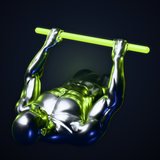
Scapular pull-ups: form, sets, and why they come before your first pull-up
A scapular pull-up is a dead hang where you pull the shoulders down and lift your body a few centimetres without bending the elbows. Own a 20-second dead hang first, then build to 10 clean reps with a one-second pause at the top. As a pull-up drill, 2 sets of 10 before your main sets is enough.
General information, not medical advice. Stop if you feel dizzy or unwell, and ask a professional about any health concern.
Where the scapular pull sits in the chain
The scapular pull is step two of the pull line. It needs one thing before it, a steady dead hang, and it opens one big thing after it, the pull-up negative.
The negative has two gates on our map: the scapular pull and the chin-up top hold. You need both. The scap pull trains the bottom of the rep, the top hold trains the top, and the negative joins them. Skip this step and the first centimetres of every pull-up go untrained.
How to do a scapular pull-up
Grip the bar overhand, just outside shoulder width, and start from a full dead hang.
- Hang with the arms locked and the shoulders relaxed up by the ears.
- Pull the shoulders down and slightly back. The elbows stay straight.
- Let the head move back a little as the chest rises.
- Pause for one second at the top.
- Lower slowly back to the relaxed dead hang.
The body rises a few centimetres. That is the whole rep. Four cues keep it honest: elbows locked, shoulders away from the ears, push the hands slightly forward into the bar, slow up and slow down.
A clean rep starts from a full dead hang, keeps the arms straight, shows a clear shoulder drop with the body rising, and returns to the hang.
The levels and the number that moves you on
Three levels, all in reps. These are the same three numbers the Calisthenics app tracks for this skill.
Move on when
A common first pull-up ladder asks for 10 to 12 consecutive scapular pulls before the next step. We use 10 as level 3. Before you start, own a dead hang of 20 seconds or more so the grip does not give out before the shoulders do.
On the app's map, a skill unlocks when the skills before it reach level 2. For the negative that means 6 scap pulls and a 10-second chin-up top hold.
The bent-elbow mistake (and two others)
Bending the elbows to get higher. This is the one almost everyone makes. The range feels too small, so the arms help. Now it is a tiny pull-up, and the shoulder blades stop doing the work you came for. Fix: lock the elbows and accept the small range. It is small by design.
Bouncing through reps. Fast reps hide a weak bottom position. Pause one second at the top and one second at the bottom.
Swinging the legs. A kick lifts the body without the shoulders. Keep the legs together and the body quiet.
If you cannot get the shoulders to move at all, film yourself from the side. Look for a gap opening between the shoulders and the ears. No gap, no rep.
Active hang: the hold version
The active hang is the same shoulder action held for time instead of repeated. Start in a dead hang, pull the shoulders down without bending the elbows, and hold with the ribs down and the legs together. The neck gets longer and the body rises slightly.
The two hangs have different jobs: a passive hang for length, an active hang for strength. Use the active hang as a warm-up on pulling days, 3 to 4 sets of 10 to 30 seconds. If you shrug back up during the hold, shorten it and reset the shoulders each set.
Dosage: as a skill and as a drill
As a skill you are building: 3 sets of 6 to 12 reps, 60 to 90 seconds of rest, two or three times a week.
As a pull-up drill: 2 sets of 10 before your pull-up sets. This keeps the shoulder-down start fresh long after you have moved past the step.
If the full version is too hard, step back:
- Foot-assisted scap pull: feet on a box or the floor take part of the weight, 3 x 10.
- Band scap pull: straight-arm shoulder depression against a band fixed overhead, 3 x 12.
- Top-hold scap pull: hold the top of each rep for 3 seconds, 3 x 5.
Pick the hardest version you can do for 6 clean reps, then work up to 10.
Why they come first
Every strict pull starts the same way. The step lists for the chin-up, the pull-up, the weighted pull-up and the one-arm pull-up all include the same instruction early: pull the shoulders down. Strict standards ask for straight arms at the bottom of each rep, so every rep you will ever count begins at the exact position the scap pull trains.
That is why the scap pull stays in your warm-up long after you own it. Beginner plans put it beside rows, slow negatives and hangs as the base for a first pull-up, often right after the top hold.
The load is small but the shoulder is overhead under full body weight. Move slowly, and stop if you feel pinching at the front of the shoulder.
Next steps: if your hang is under 20 seconds, start with the dead hang. If you already have 10 scap pulls, go to the negative pull-up, then the full pull-up guide. Not sure where you stand? The progression checker compares your numbers with each step.
Questions people ask
Should my elbows bend during a scapular pull-up?
No. The elbows stay locked for the whole rep. The movement comes only from the shoulder blades moving down, so the range is small, a few centimetres at most. If the elbows bend, you are doing a short pull-up and the drill stops training the start of the pull.
How many scapular pull-ups should I do?
As a skill, 3 sets of 6 to 12 reps with 60 to 90 seconds of rest, two or three times a week. As a warm-up drill before pull-ups, 2 sets of 10 is enough. Move on to pull-up negatives once 10 clean reps in a row feel controlled.
What is the difference between an active hang and a scapular pull-up?
They use the same shoulder action. In the active hang you pull the shoulders down and hold that position for time. In the scapular pull-up you repeat the action for reps, lowering back to a relaxed dead hang between each one.
Do scapular pull-ups help you get a first pull-up?
They train the first part of every pull, where the shoulders move down before the arms bend. Most first pull-up ladders include them next to rows, top holds and slow negatives. On their own they will not build a pull-up; they are one link in the chain.
Made by EASYTECH, who also make Calisthenics.