What is calisthenics? The meaning, the skills, and how it gets harder without weights
Calisthenics is strength training with your own body weight: pull-ups, push-ups, dips, squats, and skills like the handstand or the front lever. The word joins Greek roots for beauty and strength. You make an exercise harder by changing your body position instead of adding weight, and each skill is a chain of steps.
General information, not medical advice. Stop if you feel dizzy or unwell, and ask a professional about any health concern.
Calisthenics is training with your own body as the weight. A push-up, a pull-up, a dip and a squat are calisthenics. So are the skills people film in parks: the handstand, the muscle-up, the front lever, the planche, the human flag. The difference between the two is only how many steps stand in between.
What the word means
Dictionaries define calisthenics as gymnastic exercises designed to develop physical health and vigor, usually performed with little or no special apparatus. The word dates from 1840 to 1850. It joins cali-, from the Greek kallos, beauty, with the Greek sthenos, strength. Beauty and strength, in one word.
The modern meaning is narrower. Calisthenics today usually means bodyweight strength training and the skills built from it, from your first knee push-up to a one-arm pull-up.
How it gets harder without adding weight
A barbell gets heavier when you add plates. Your body weight stays roughly the same, so calisthenics changes position instead. Raise the feet, lower the hands, move to one arm or one leg, straighten a tucked leg. Each change moves your centre of mass away from the working joint, and the same body weight becomes a harder load.
That is why every skill is a chain of steps.
Each step ends at a set count or a set time. Three sets of 8 clean reps is the classic rule for most rep steps. A 30-second hold is the rule for easy holds. You do the step until you hit the number, then you change position.
Two kinds of arm strength
Calisthenics splits arm work in two. Pull-ups, dips and push-ups bend the elbow. Levers and the planche keep it locked. Coaches train the two separately.
- Bent-arm: 174 skills on our map, from the push-up and the row to the one-arm pull-up.
- Straight-arm: 122 skills, including the front lever, back lever, planche, human flag and L-sit supports.
Locked means locked. In the classic gymnastics progressions, the elbows stay fully straight in planche and lever work, almost straight still counts as bent, and bending makes the position much easier, so it hides your real level. The frog stand is the one static in that progression done with bent arms.
Keep bent-arm work, rows and push-up variations, next to the holds. Straight-arm holds load the elbow and the biceps tendon hard, so add seconds or difficulty in small steps, never both in the same week.
Holds, reps and dynamic moves
Every skill on the map has a type, and the type decides how you count it.
| Type | What it is | How it is counted | Skills on the map |
|---|---|---|---|
| Strength | A controlled movement: push-up, pull-up, pistol squat | Reps | 262 |
| Hold | A position held for time: plank, support, front lever | Seconds | 93 |
| Dynamic | Swings, releases and rolls that use momentum | Reps | 35 |
| Power | Reps that only work with speed: claps, jumps, kips | Reps | 33 |
| Balance | Skills limited by balance: handstand, elbow lever, pistol squat | Mostly seconds | 27 |
| Mobility | Range of motion: splits, bridge, pancake | Seconds, reps or position checks | 22 |
Holds, reps and dynamic moves also train differently. Coaches set hold sets at about 60 to 70% of your best time, repeated. A rep step works at 3 sets of 5 to 8. Balance skills like the handstand are practised in short, frequent blocks.
What the 472-skill map holds
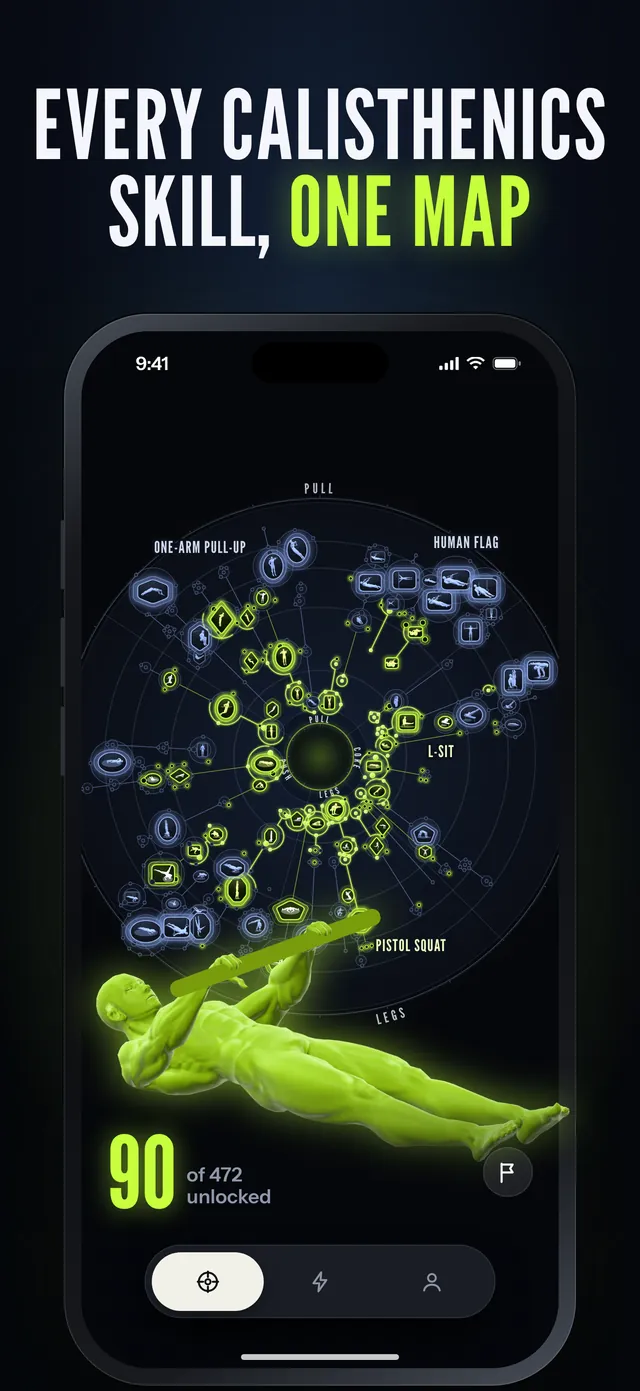
We grouped calisthenics into four regions and fifteen domains. The farther a skill sits from the center, the harder it is.
| Region | Skills | Domains |
|---|---|---|
| Pull | 155 | Hang and grip, bent-arm pull, straight-arm pull (levers, flag, cross), bar and rings dynamics |
| Push | 156 | Bent-arm push, straight-arm push (planche, maltese), handbalance (handstand, presses, elbow lever) |
| Core | 89 | Compression (L-sit, V-sit, leg raises), body line (plank, hollow, dragon flag), back line (bridge), floor dynamics |
| Legs | 72 | Squat, posterior chain (hinge, nordic curl), jumps and conditioning, flexibility (pike, pancake, splits) |
Of those 472 skills, 62 are one-arm or one-leg skills, and 127 need only the floor. The calisthenics skills chart lists every one of them with its tier, the step before and after, and its three numbers.
Street workout and its rules
Street workout is calisthenics on outdoor bars and in parks. It has grown its own competitions, with two kinds of rules worth knowing even if you never compete.
Records. Official world records have strict rules. A pull-up counts when the chin goes above the bar with no swing, and reps stop counting once form is lost. A record front lever has the body fully horizontal and straight, arms straight, for at least 35 seconds for men, while the women's record category is a 15-second straddle front lever.
Streetlifting. Streetlifting competitions run weighted pull-ups and dips, either for the heaviest single rep or for the most reps with a fixed weight. The pull-up rule is strict: start hanging with straight elbows, get the chin past the bar both vertically and horizontally, and any kip or sway voids the rep.
Those standards sit far above what you need to train. On our map, level 3 of a skill means ready to move on, not record-ready.
What the evidence says
- 8 weeks of calisthenics: untrained adults trained calisthenics against a control group. The training group's push-up score rose 16.4% and pull-up score 39.2%; the control group did not change.
- 4 weeks of harder push-ups: harder push-up variations three days a week raised bench-press strength as much as bench training did.
Both point the same way: moving through harder bodyweight variations builds real strength, with nothing more than a bar and the floor.
Where to start
Pick one line and its first step. The calisthenics for beginners guide gives the five starting skills and a self-test. The equipment guide covers what to buy, if anything. Train within your limits and stop if something hurts.
Questions people ask
What does calisthenics mean?
The word joins the Greek kallos, beauty, with sthenos, strength. Dictionaries date it to the 1840s and define it as exercises for health and vigor done with little or no special equipment. Today it mostly means bodyweight strength training and the skills built on it.
Is calisthenics the same as street workout?
Street workout is calisthenics done on outdoor bars and parks, and it has its own competitions with freestyle moves and record rules. Calisthenics is the wider term: it also covers floor training at home, rings and the gymnastics-style holds.
Is calisthenics good for building strength?
Yes. In one trial, beginners who trained calisthenics for 8 weeks raised their pull-up score by 39% and their push-up score by 16%, while a control group did not change. Another found harder push-up variations built bench-press strength as well as bench training.
Do you need equipment for calisthenics?
Not to start. On our map, 127 of the 472 skills need nothing but the floor. A pull-up bar opens most of the pull region, and rings, parallettes and parallel bars open the rest.
Sources
- Thomas et al. 2017, Isokinetics and Exercise Science: effects of a calisthenics training intervention on posture, strength and body composition 8 weeks of calisthenics raised push-up scores by 16.4% and pull-up scores by 39.2% against a control group.
- Kotarsky et al. 2018: progressive calisthenic push-up training, muscle strength and thickness Harder push-up variations raised bench-press strength as much as bench training over 4 weeks.
Made by EASYTECH, who also make Calisthenics.