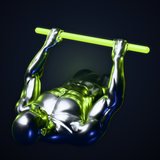
Archer pull-ups: form, per-side levels, and the bridge to one-arm pulling
An archer pull-up pulls your chin over one hand while the other arm straightens along the bar. Start once you have 3 to 5 chest-to-bar pull-ups. The levels are 1, 3 and 5 reps per side, counted on your weaker side, with the helper arm straight. At 5 per side, move to typewriters or one-arm negatives.
General information, not medical advice. Stop if you feel dizzy or unwell, and ask a professional about any health concern.
Six steps before the archer
The archer pull-up sits six skills deep in the Pull region. Here is the longest line into it.
The one you can't skip is the chest-to-bar pull-up. It teaches you to pull higher than the chin, and the archer happens at that height, over one hand.
Chest-to-bar first
Overhand grip slightly wider than the shoulders. Pull the shoulders down before the arms bend, pull fast, drive the elbows back, lift the chest and touch the bar around the sternum. Lower under control.
Move on when
Start chest-to-bar work at about 8 to 10 strict pull-ups. Train it fresh, early in the session: 5 to 8 sets of 1 to 3 fast reps with 2 minutes of rest, twice a week. Long slow sets are the common mistake here; speed gives height. If the chest rounds at the top, lift it and extend the upper back.
How to do an archer pull-up
Wide overhand grip on a bar, or rings. Start from a dead hang.
- Grip wide and hang with straight arms.
- Pull toward one hand.
- Let the other arm straighten along the bar.
- Bring the chin over the working hand.
- Lower to the centre and repeat to the other side.
Move on when
The helper arm stays straight
This is the cue that makes the exercise. The straight arm gives light support; the bent arm does the pull. When the helper arm bends, it turns into a lopsided two-arm pull-up and the one-arm training effect is gone.
Cues: helper arm straight, chin over the working hand, pause at the top, shoulders down the whole time.
Mistakes and fixes:
- Helper arm bends. Go back to an easier assisted one-arm drill until it stays straight.
- Rushing out of the top. Pause at the top on each side.
- Too wide too soon. Wider is harder. Start with the hands a little closer and widen as reps come.
Dosage, and what to do when 3 reps is too many
Working dose: 3 sets of 3 to 5 reps on each side, resting 2 to 3 minutes between sets, on two days a week.
Move on at 5 clean reps per side. Some ladders push archers to 2 sets of 9 per side before any one-arm work, and that extra volume is a fine target if your elbows like it. At 5 per side you can start the next step while the archer keeps climbing.
The start is the hard part: the helper side needs straight-arm strength and resilient elbow and shoulder tissue, and most people cannot begin with sets of 3 to 5. If that is you, build into it:
- Archer top hold: hold the chin over one hand, 3 x 5 seconds per side.
- Archer negative: lower slowly over the working hand, 3 x 2 per side.
- Mixed-grip uneven pull-up: bias the pull about 60/40 toward one side, 3 x 4 per side.
Typewriter pull-ups: the top-range version
The typewriter holds the top of a wide pull-up and slides the chin along the bar from one hand to the other. It sits after the archer.
Start it at 3 to 5 archers per side. The chin stays at bar height for the whole slide, and the straight arm presses down over the bar with the fingers forward instead of hanging behind it. If you drop as you slide, build a wide top hold for 3 x 15 seconds first. Then side pulls, 3 x 3 per side, and partial slides, halfway and back. Train 3 to 4 sets of 1 to 3 traverses with 2 to 3 minutes of rest. Slow beats fast; speed hides the weak spot.
The bridge to one arm
On our map the archer leads to two places: the typewriter, and the one-arm chin-up negative. The negative has a second gate, the weighted pull-up. The archer gives you the one-sided top range; the weighted pull-up gives you raw pulling strength. You need both before slow one-arm lowerings make sense.
Most pulling ladders use the same order: archers are the last step before one-arm pull-ups. The full chain is in the one-arm pull-up progression. If you are still building toward chest-to-bar, go back to the pull-up guide.
Look after the elbows
Long time under tension at the top loads the elbows, and the straight helper arm loads the elbow and shoulder in extension. One-arm style training is a common cause of elbow tendon pain. Build volume slowly, keep the helper arm slightly active rather than hanging on the joint, and stop a set when the reps start to change shape.
Questions people ask
How many pull-ups do I need before archer pull-ups?
On our map the step before the archer is the chest-to-bar pull-up, and you start archers at about 3 to 5 chest-to-bar reps. Chest-to-bar itself starts at about 8 to 10 strict pull-ups. So plan on roughly 10 pull-ups before your first archer set.
Should the straight arm help in an archer pull-up?
A little. It stays straight and gives light support while the bent arm does most of the work. If you feel it bend, it is taking too much of the load; go back to an easier assisted version until it stays straight through the rep.
What is the difference between archer and typewriter pull-ups?
An archer pull-up goes up to one hand and comes back down through the bottom before the other side. A typewriter stays at the top and slides the chin along the bar from one hand to the other without dropping. Typewriters come after archers.
Do archer pull-ups lead to the one-arm pull-up?
They are one of two gates before one-arm negatives on our map, the other being the weighted pull-up. Archers are the classic last step before one-arm pulling, often trained up to 2 sets of 9 per side.
Made by EASYTECH, who also make Calisthenics.