Calisthenics workout plan: free 2, 3 and 4 day weeks, and the numbers that move you on
A calisthenics workout plan for most people is 3 full-body sessions a week on non-consecutive days; beginners can use 2, intermediates 3 to 4. Train skill work first, then strength: 3 sets of 5 to 8 reps, or holds at 50 to 70% of your best. Move on at each step's level 3, not by the calendar.
General information, not medical advice. Stop if you feel dizzy or unwell, and ask a professional about any health concern.
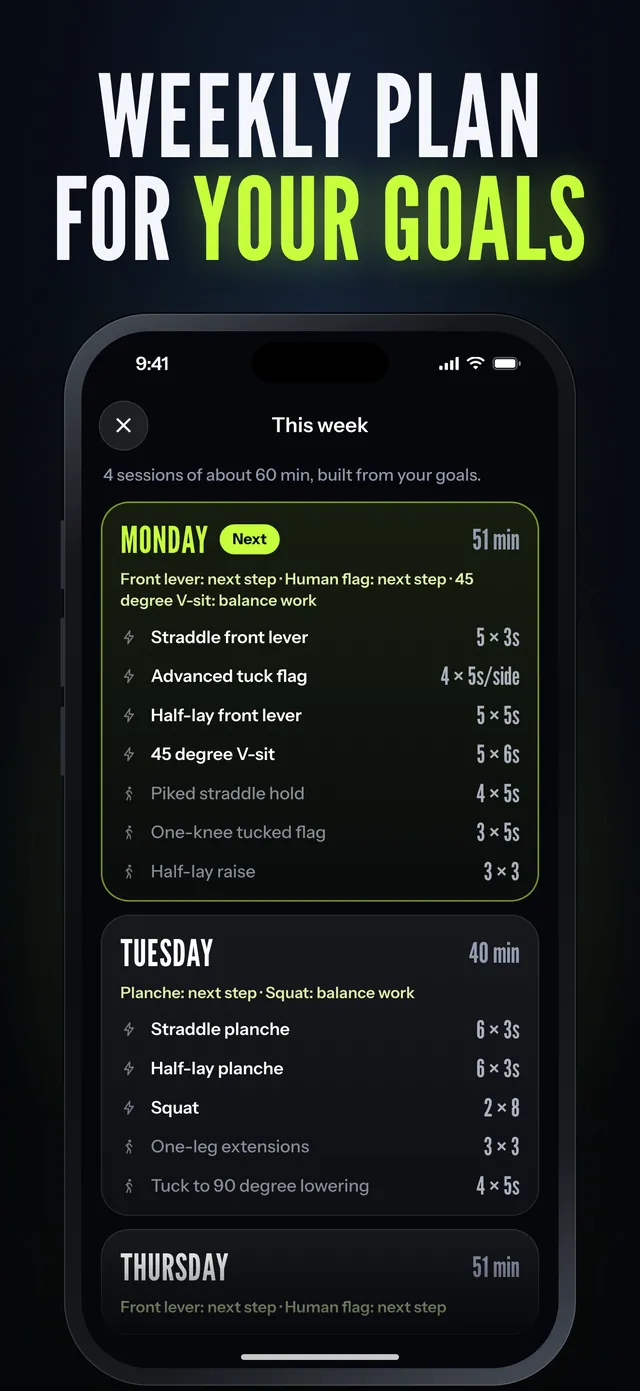
A good calisthenics week fits on one page. Pick the number of days you can keep, train skill work while you are fresh, and change step when a number says so. Below are three free weeks you can print today, the dosage behind them, and the one rule that replaces every "week 6" in other plans.
Pick your week: 2, 3 or 4 days
The ACSM recommends 2 to 3 days a week for novices and 3 to 4 for intermediates. Full-body and split routines give similar strength and muscle growth when weekly volume is equal, so the choice can follow preference. Pick the week you will still be doing in three months.
The 2-day week: the floor
For busy weeks or a first start. Same session twice, at least two days apart.
| Day | Session |
|---|---|
| Monday | Full body A |
| Tuesday | Rest |
| Wednesday | Rest |
| Thursday | Full body A |
| Friday to Sunday | Rest or a walk |
Full body A, as three alternating pairs plus core:
- Pull-up step + squat step, 3 sets each
- Dip or support step + hinge step (glute bridge, hamstring slide), 3 sets each
- Row step + push-up step, 3 sets each
- Core: an anti-extension hold (plank or hollow hold), an anti-rotation move, a back extension
Two sessions a week is the floor in our Foundations track. Every exercise uses the hardest step you can do for 5 clean reps.
The 3-day week: the default
The classic layout: full body on three non-consecutive days, with a short skill block first.
| Day | Session |
|---|---|
| Monday | Skill block 5-15 min + Full body A |
| Tuesday | Rest |
| Wednesday | Skill block 5-15 min + Full body A |
| Thursday | Rest |
| Friday | Skill block 5-15 min + Full body A |
| Weekend | Rest |
The skill block is where your goal lives: wall handstand, frog stand, L-sit steps, tuck front lever. Keep it short and stop each attempt before it gets sloppy. Balance skills like the handstand can also take a 5 to 15 minute block on rest days.
The 4-day week: push and pull
For when a full-body session runs too long. Two push or upper days, two pull or lower days.
| Day | Session |
|---|---|
| Monday | Push: dip, push-up step, pike push-up step, core |
| Tuesday | Pull and legs: pull-up step, row step, squat or single-leg step, hinge |
| Wednesday | Rest |
| Thursday | Push: skill block, dip, push-up step, pike push-up step |
| Friday | Pull and legs: skill block, pull-up step, row step, nordic or hamstring step |
| Weekend | Rest |
Each muscle group gets two sessions a week, and you have room for more sets per pattern.
The order inside every session
Strength gains are greatest in the exercises you do first, according to a meta-analysis of 11 studies. That is why the hard things go early.
- Prepare, 5 to 10 min: joint circles for wrists and shoulders, an easy version of the main drill, one body-line hold.
- Skill or balance: handstand, elbow lever, kick-ups.
- Power: explosive pull-ups, clap push-ups, jumps, only once the strict version is at level 2.
- Main strength or holds: the next step on your goal path.
- Supporting strength: a rep exercise for the same pattern at 5 to 8 reps.
- Core.
- Mobility: stretching goes last.
Dosage by the numbers
Rep steps. 3 sets of 5 to 8, stop 1 to 2 reps before failure. Start at 3 x 5, add one rep per set each session, and at 3 x 8 move to the next step and start again at 3 x 5. Rest 90 to 180 s. 60 to 120 s is enough for untrained people, and over 2 minutes works better for trained ones.
Holds. Each set at 50 to 70% of your best recent hold, enough sets for 30 to 60 s of total holding, 3 to 6 sets, 90 to 180 s of rest, 2 to 4 sessions a week. Example: best hold 10 s gives 6 sets of 6 to 7 s. Best hold 20 s gives 4 to 5 sets of 12 to 13 s. If your best is under 5 s, do 4 to 6 short attempts of 2 to 3 s with full rest instead.
Lowerings. For a first pull-up, dip or nordic curl: 2 to 3 sets of 2 to 3 slow lowerings, 3 to 5 s each, about 3 minutes of rest, and at most 10 lowerings per session.
Five tracks, and who each one is for
Our programmes come in five tracks. Each opens at a set of levels and moves through phases that end on numbers.
| Track | Start when | Sessions a week |
|---|---|---|
| Foundations | No push-up or pull-up needed | 2-3 |
| Strength basics | 20 push-ups, 5 pull-ups, 5 dips | 3-4 |
| Muscle with bodyweight | 10 push-ups, 8 inverted rows | 3-4 |
| Rings basics | 10 push-ups, 1 pull-up, 1 dip, and a pair of rings | 2-3 |
| Weighted basics | 10 pull-ups, 10 dips, and a belt or vest | 2-3 |
Strength basics works in 3 to 6 reps with 2 to 4 minutes of rest and moves through harder levers, then one side at a time. Muscle with bodyweight uses more reps, 8 to 20, closer to failure. The beginner guide walks through all three Foundations phases and their exit numbers.
The move-on rule: levels, not weeks
Every skill on the map has three levels. Level 3 is the move-on number: 3 sets of 8 for most rep steps, 30 s for easy holds, 60 s for long body-line holds, 10 s for the hardest statics. When you reach it, the next step becomes your main exercise and the old one turns into a warm-up.
One number per step, printed on the map, so you never guess. If you love volume, 3 x 12 on the full pull-up is a fine extra target before weighted work. If two sessions in a row add nothing, keep the same dose for a week before changing anything.
Lighter weeks: no schedule, a rule
A deload is a period of reduced training stress to recover, and you do not need one on a fixed schedule. A planned full week off in the middle of nine weeks gave smaller lower-body strength gains and the same muscle size, so lighter beats off.
Our rule: take a lighter week when something hurts, when sleep has been poor, or after two flat weeks. Drop a set from each exercise or step back one progression, then return.
For the sessions themselves, see calisthenics at home for a floor-only week and the calisthenics back workout for a pull day. The skills chart shows which step comes next on any line, and the skill path finder pulls out the chain to your goal.
Questions people ask
How many days a week should I do calisthenics?
Two to three if you are new, three to four once you have the basics. With the same weekly volume, full-body and split routines give similar strength and muscle gains, so pick the schedule you can keep.
Is full body or a split better for calisthenics?
Both work when the weekly volume matches. Full body three times a week is the classic beginner layout. A push and pull split over four days fits more sets in once each session gets long. Results come out the same.
How long should a calisthenics workout be?
A classic full-body routine runs 45 to 60 minutes: a 5 to 10 minute warm-up, then nine exercises in pairs. Our floor session takes 20 minutes. What matters more is the number of hard sets per week and keeping skill work first, while you are fresh.
When should I make my calisthenics workout harder?
When you reach the move-on number of the step you are on, usually 3 sets of 8 reps or 3 holds of 30 seconds, change to the next step and drop the reps back to 5. Do not change step on a calendar date.
Sources
- Ramos-Campo et al. 2024: split versus full-body resistance training, systematic review with meta-analysis With equal weekly volume, split and full-body routines give similar strength and muscle growth.
- ACSM position stand: progression models in resistance training for healthy adults (2009) 2 to 3 days a week for novices, 3 to 4 for intermediates, 4 to 5 for advanced trainees.
- Nunes et al. 2021: exercise order, strength and muscle growth, systematic review and meta-analysis Strength gains are greatest in the exercises done early in a session.
- Grgic et al. 2018: rest interval duration and muscular strength, systematic review Rests over 2 min help trained people most; 60 to 120 s is enough for untrained people.
- Coleman et al. 2024: the effects of a one-week deload period during resistance training A full week off mid-programme gave smaller lower-body strength gains and the same muscle size.
Made by EASYTECH, who also make Calisthenics.